

You watch the pros rip ATPs and spin dinks on YouTube. Then you try it yourself and hand your opponent free points. The gap between what works for pros and what works for beginners is massive. These five habits are keeping you stuck.
Baseline Power Trips
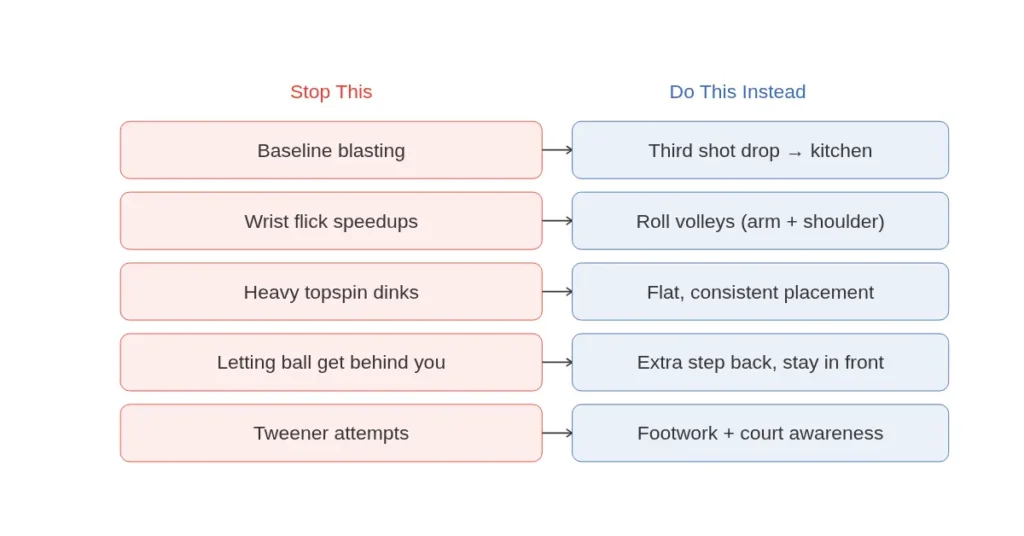
You step up to the baseline and rip a forehand as hard as you can. It feels great when it works. But it probably will not work often enough to matter. Too many beginners, especially those coming from tennis, try to win points from the back of the court.
The kitchen line is where points are won and lost. From the kitchen, you have the most control over the ball. You can attack low balls or defend against hard shots. If you stay back and keep driving, any opponent who knows how to use angles will pick you apart. They will drop the ball short and watch you scramble forward.
The same logic applies to the transition zone. Blasting the ball from midcourt is usually a bad idea. It gives your opponent plenty of time to react and often leaves you off balance.
The fix is straightforward. Develop a reliable third shot drop. This shot is your ticket to the kitchen. A soft, looping shot that lands in the kitchen forces your opponent to hit up. That gives you time to move forward and take control of the net. Once you are in position, then you can unleash your offensive game.
Wrist Flick Speedups
You watch the pros hit those quick wrist flicks at the net and the ball rockets down at impossible angles. So you try it yourself. The ball either dives straight into the net or sails three feet long.
That flick shot requires pinpoint control and thousands of reps. Most beginners do not have that kind of muscle memory yet. So your speedups become wildly inconsistent, and you hand over easy points.
Instead, master roll volleys first. Focus on a low-to-high swing path that creates topspin through your shoulder and arm, not just your wrist. This gives you control over the ball’s trajectory. You can keep it low over the net and make it dip down into the court.
Build that consistency before you try adding flair. Your opponents will have a much harder time handling a controlled roll volley than a wild flick that might go anywhere. Players who understand shot selection know that reliability beats flash.
Topspin Dinks Too Early
You have seen the topspin dink that pros use. The ball dips aggressively and lands low in the kitchen. It looks like the ultimate weapon.
Here is the problem. There are only 14 feet between the two kitchen lines. That is very little room for error. When you try heavy topspin without the proper foundation, the ball usually floats too high or hits the net. A high dink is a death sentence in pickleball. Your opponent will smash it at your feet.
Most amateur attempts at topspin dinks fail because the wrist is not stable. You need a locked wrist and a specific brushing motion to generate the right spin.
The smart move is to keep your dinks flat and steady. Focus on consistent placement first. Work on landing your dinks in the same spot over and over. Aim for the middle of the kitchen or the corners. Once you can land 50 straight dinks without missing, then you can start adding finesse.
Solid placement beats flashy mistakes every time.
Ball Getting Behind You
You hustle to the ball, stretch your paddle out, and try to save it. But the ball is already behind you. Your reach is awkward. Your balance is off. You pop the ball up or miss it completely.
It might look like the pros can reach back and save anything, but they are the exception. Most of the time, letting the ball get behind you leads to a weak, floating return or a miss.
The fix is simple but takes effort. Hustle to keep the ball in front of you at all times. If you are even slightly late, take an extra step back. Give yourself more space. It is better to take one more step backward and hit a controlled shot than to let the ball get past you and hit a desperate reach.
This is especially important when you are moving forward from the transition zone. You might be tempted to keep your forward momentum and try to hit the ball early. But if the ball is already past your body, stop. Take that extra step back first.
Good positioning makes every shot easier. Bad positioning makes you scramble. And scrambling leads to common beginner mistakes that hand your opponent free points.
Tweener Heroics
You see a jaw-dropping tweener on a highlight reel and think you could do that. The reality is that tweeners require perfect timing, body control, and a whole lot of luck. Even most pros avoid them unless there is absolutely no other option.
When you try one as a beginner, you are more likely to trip, pull a muscle, or just look silly. The risk of injury alone is not worth the tiny chance of pulling it off.
The better approach is to never need a tweener in the first place. Focus on your footwork. Move your feet to get into position instead of reaching or lunging. Work on your court awareness. If the ball is going past you, you probably took a bad angle or misread the shot.
Skip the highlight-reel heroics. Build a game based on solid fundamentals and smart positioning. You will win more points, avoid injuries, and look like a player who actually knows what they are doing. Players who prepare properly know that consistency beats highlights.
常见问题
为什么初学者不应该模仿职业匹克球运动员的技术?
职业球员拥有数千小时的肌肉记忆,能够帮助他们从危险击球中迅速恢复。而初学者尚未打下这样的基础。在掌握基本功之前就尝试诸如手腕甩动加速、强力上旋轻击和胯下击球等高阶技巧,会导致发挥不稳定、容易失误,并最终令人沮丧。.
我应该怎么做才能避免从底线大力击球?
练就一记稳定的第三拍下坠球,让球轻柔地落入厨房区。这记下坠球能让你进入厨房区,而厨房区正是得分的关键所在。如果只是退守后场大力抽射,那些角度意识好的对手很容易就能找到破绽。.
什么时候可以在轻击球时加入上旋?
一旦你能够稳定地连续击出50个平击球而不失误,就应该开始练习。首先要练习落点和稳定性,然后逐渐增加轻微的旋转。在14英尺的范围内打出强烈的上旋球需要手腕锁定和特定的刷球动作,这需要时间来练习。.
如何防止球滚到我身后?
时刻注意保持球在你身前。即使稍稍慢了一步,也不要伸手,而是后退一步。后退一步控制好击球,总比仓促伸手把球打高要好得多。.