A standard pickleball court measures 20 feet wide by 44 feet long, totaling 880 square feet. That makes it roughly one-third the size of a doubles tennis court and identical in footprint to a doubles badminton court. If you’ve ever stepped onto a pickleball court and thought it felt compact, you’re not imagining things.
Understanding the proper pickleball court dimensions helps you appreciate why the game plays the way it does.
Measurements
Every pickleball court follows the same specifications set by USA Pickleball, whether you’re playing singles or doubles. The court doesn’t change size between the two formats, which is one thing that sets it apart from tennis and badminton.
The Court
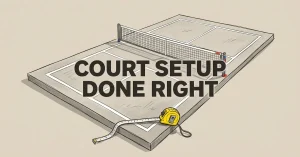
The playing surface is a rectangle measuring 20 feet wide and 44 feet long. A net divides the court in half, sitting at 36 inches tall at the sidelines and 34 inches at the center. On each side, a non-volley zone (the kitchen) extends 7 feet from the net. Behind the kitchen, two service areas each measure 15 feet deep and 10 feet wide.
Total Space
The court itself covers 880 square feet, but you need more room than that to play comfortably. USA Pickleball recommends a minimum total area of 30 by 60 feet, which is 1,800 square feet. For tournament play, that jumps to 34 by 64 feet. The extra space gives players room to chase down lobs and wide shots without running into fences or walls.
| Component | Measurement | Details |
|---|---|---|
| Court Length | 44 feet | Same for singles and doubles |
| Court Width | 20 feet | Same for singles and doubles |
| Baseline to Net | 22 feet | Each side |
| Non-volley Zone | 7 feet | From net (the "Kitchen") |
| Net Height (Sidelines) | 36 inches | Standard height |
| Net Height (Center) | 34 inches | 2-inch dip |
How Big Is a Pickleball Court Compared to a Tennis Court?
A pickleball court is about one-third the size of a doubles tennis court. The doubles tennis court measures 36 feet wide by 78 feet long, giving it 2,808 square feet of playing surface compared to pickleball’s 880 square feet. You can fit roughly four pickleball courts inside a single tennis court with standard spacing, which is exactly why so many tennis facilities now add pickleball lines.
Net Height
The net height difference matters more than people realize. A tennis net stands 42 inches at the posts and 36 inches at the center. A pickleball net is 36 inches at the sidelines and 34 inches in the middle. That lower center point in pickleball encourages a different style of play, with more dinking and soft shots near the kitchen line.
Why Size Matters
The smaller court changes everything about how you move and strategize. Tennis demands covering a much larger area, which rewards big serves, deep groundstrokes, and serious athleticism. Pickleball’s compact court puts a premium on placement, reaction time, and net play. It’s one reason the sport is so accessible to a wider range of ages and fitness levels.
Comparisons
A pickleball court size comparison against other court sports reveals some interesting patterns. Here’s how the major ones stack up:
| Sport | Length | Width | Total Area | Relative Size |
|---|---|---|---|---|
| Pickleball | 44 feet | 20 feet | 880 sq ft | Baseline |
| Tennis (Singles) | 78 feet | 27 feet | 2,106 sq ft | 2.4x larger |
| Tennis (Doubles) | 78 feet | 36 feet | 2,808 sq ft | 3.2x larger |
| Basketball | 94 feet | 50 feet | 4,700 sq ft | 5.3x larger |
| Indoor Soccer | 82 feet | 50 feet | 4,100 sq ft | 4.7x larger |
| Volleyball | 59 feet | 29.5 feet | 1,741 sq ft | 2.0x larger |
Badminton Overlap
This is the one that surprises most people. A doubles badminton court and a pickleball court share the exact same dimensions: 20 by 44 feet. The difference is all in the details. Badminton nets are much taller at 5 feet 1 inch at the edges and 5 feet at the center, compared to pickleball’s roughly 3-foot net. The line markings, service rules, and zones are also completely different. But the shared footprint means converting a badminton court to pickleball is straightforward.
Racquetball Context
A racquetball court is 20 feet wide by 40 feet long, making it just 4 feet shorter than a pickleball court. Of course, racquetball is played in an enclosed room where all four walls and the ceiling are in play, so the comparison only goes so far. Still, the similar width means the lateral movement patterns have some overlap.
Strategy
Court dimensions aren’t just trivia. They directly shape how you play and what skills matter most in each sport.
The smaller pickleball court creates a game built around the kitchen line. Since you don’t have to cover much ground, points tend to hinge on quick hands, angle creation, and patience rather than pure speed or power. Compare that to tennis, where you might sprint 30 feet to reach a wide ball.
Here are a few ways court size influences your pickleball strategy:
- The 7-foot kitchen zone makes soft touch shots essential
- The 20-foot width rewards precise angle play over power
- The short baseline-to-net distance keeps rallies fast and reactive
If you’re coming from tennis, expect an adjustment period. The court will feel small at first, and you’ll likely overhit shots until you recalibrate your sense of distance. Players switching from badminton tend to adapt faster since the footprint is familiar, though the lower net and different ball physics still take some getting used to.
Conversions
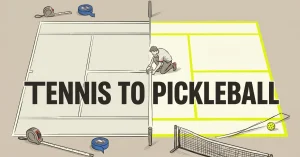
One reason pickleball has grown so quickly is how easy it is to set up courts on existing surfaces. A single tennis court, with its total footprint of roughly 60 by 120 feet, can accommodate up to four pickleball courts using the minimum 30 by 60 foot spacing.
Many facilities add pickleball lines in a contrasting color on top of existing tennis court markings, then use portable nets to switch between sports. Badminton courts convert even more easily since the boundary dimensions already match. Basketball courts and gymnasium floors also work well, since a standard high school gym floor has plenty of room for multiple pickleball courts.
Knowing how pickleball court dimensions relate to other sports makes the conversion process simple. Whether you’re a facility manager or just someone taping lines on a driveway, the 20 by 44 foot footprint is manageable almost anywhere.
FAQs
Can you play pickleball on a tennis court without modifications?
You can, but you’ll need to add temporary pickleball lines and use a portable net. The tennis net is too high and too wide for regulation pickleball play. Tape or chalk works fine for casual games.
Is a pickleball court the same size for singles and doubles?
Yes. Unlike tennis or badminton, pickleball uses the same 20 by 44 foot court for both singles and doubles play. The only difference is strategy and positioning.
Why is the pickleball kitchen 7 feet deep?
The 7-foot non-volley zone prevents players from standing at the net and smashing every ball. It creates a strategic balance between power and finesse, which is central to pickleball’s appeal.
What’s the minimum space needed to build a pickleball court?
USA Pickleball recommends at least 30 by 60 feet of total space. The court itself is 20 by 44 feet, but you need buffer room around all sides for safe play and movement.
Can you convert a badminton court into a pickleball court?
The court dimensions are identical at 20 by 44 feet, so the conversion is easy. You’ll need to add pickleball-specific lines, lower the net to 34 inches at center, and swap out the equipment.