

Understanding pickleball’s court dimensions helps you play smarter and set up your own court correctly. Here’s everything you need to know about the 20-by-44-foot playing area.
Overview
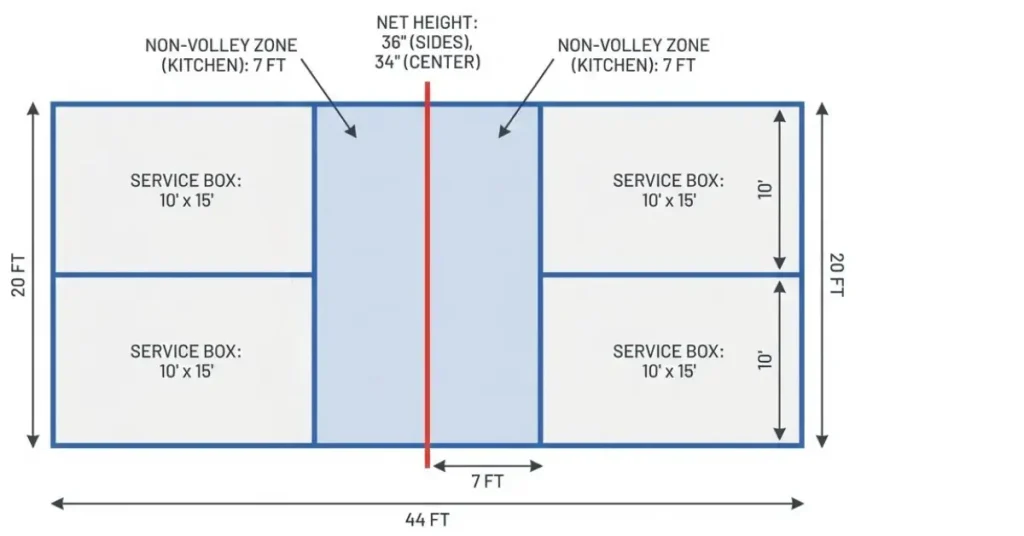
A regulation pickleball court measures 20 feet wide by 44 feet long. This applies to both singles and doubles play, making pickleball unique among racquet sports. The compact size contributes to the game’s accessibility and fast-paced nature.
The court uses the same dimensions whether you’re playing indoors or outdoors. This standardization, established by USA Pickleball, ensures consistent gameplay across all venues.
Court Layout
Basic Structure
The court divides into several distinct zones. A net bisects the playing area at the center, positioned 36 inches high at the sidelines and 34 inches at the center. This slight sag affects shot strategy, particularly for serves and returns.
Each side of the net contains identical zones. The court’s symmetry means players experience the same spatial challenges regardless of which end they’re defending.
Service Areas
Two service boxes occupy each side of the court. These rectangles measure 10 feet wide by 15 feet deep. A centerline divides them, running perpendicular to the net from the non-volley zone to the baseline.
Players must serve diagonally into the opposite service box. The right service court receives serves when the server’s score is even, while the left court receives serves on odd scores.
Non-Volley Zone
The Kitchen
The non-volley zone extends 7 feet from the net on both sides. Players commonly call this area “the kitchen.” The zone includes the painted lines, meaning if you step on the line, you’re in the kitchen.
You cannot volley the ball while standing in this zone. Momentum also matters—if you volley and your forward motion carries you into the kitchen, that’s a fault. You must establish both feet outside the zone before volleying.
Strategic Importance
This zone prevents players from camping at the net and smashing every shot. It forces a more strategic game that balances power with placement and patience.
Many points are won or lost based on kitchen line positioning. Advanced players hover just behind this line, maximizing their court coverage while staying legal for volleys.
Baseline Area
Service Line
The baseline marks the back boundary of the court. This line runs parallel to the net at 44 feet from the opposite baseline. Servers must keep both feet behind this line when serving.
The 15-foot depth from the non-volley zone to the baseline creates the service boxes. This space accommodates the serve’s bounce and return, allowing rallies to develop.
Playing Depth
The area behind the kitchen line offers the most room for groundstrokes and defensive positioning. Players often retreat here when opponents execute strong offensive shots, using the additional time to prepare their returns.
Boundary Lines
Sidelines
The sidelines run the full 44-foot length of the court. These boundaries remain the same for singles and doubles play, unlike tennis where singles uses narrower lines.
Balls landing on any boundary line are considered in. This rule applies to all lines—sidelines, baselines, centerline, and kitchen line. Only a ball landing completely outside a line is out.
Centerline
The centerline divides the service areas on each side. It runs from the kitchen line to the baseline, creating two 10-foot-wide service boxes per side.
This line only matters during the serve. Once the ball is in play after the return, players can hit to any part of the opponent’s court.
Net Specifications
Height Requirements
The net measures 36 inches at the sidelines and sags to 34 inches at the center. Posts or other support systems hold the net at the proper height outside the sidelines.
This two-inch differential might seem minor, but it influences shot selection. Many players aim for the center during dinking exchanges, taking advantage of the lower net height.
Net Material
Regulation nets use mesh tight enough to prevent the ball from passing through. The top of the net typically features a white tape or binding for visibility and durability.
Surface Markings
Line Width
All court lines should be 2 inches wide. The lines are part of the court—a ball touching any part of a line is in play.
White or yellow lines provide the best visibility against most court surfaces. Indoor courts often use colored playing surfaces with contrasting lines.
Color Standards
While no official rule mandates surface color, most outdoor courts use green or blue surfaces. Indoor facilities might use wood, rubber, or synthetic surfaces in various colors.
The key requirement is contrast between the surface and lines. Players need to quickly determine whether balls land in or out during fast exchanges.
Clearance Space
Minimum Requirements
USA Pickleball recommends a minimum playing area of 30 feet wide by 60 feet long. This provides 5 feet of clearance beyond each sideline and 8 feet beyond each baseline.
This buffer zone prevents injuries and allows players to pursue balls hit beyond the court boundaries. Tournament play often requires additional space for spectators and officials.
Optimal Spacing
When space permits, 34 feet by 64 feet offers better playability. The extra room accommodates aggressive playing styles and reduces collision risks during doubles play.
Multiple courts placed side by side should maintain at least 10 feet between sidelines. This prevents interference between adjacent games.
Conversion Guidelines
Tennis Courts
A standard tennis court can accommodate four pickleball courts. The tennis court’s 36-foot width and 78-foot length provide ample space for multiple layouts.
Temporary lines using tape or chalk allow tennis facilities to offer pickleball without permanent modifications. Many tennis centers use this approach to serve both sports.
Badminton Courts
Badminton courts measure 20 feet wide—identical to pickleball width. However, at 44 feet long, badminton courts fall short of the 44-foot regulation requirement by several feet.
Some facilities use badminton courts for recreational pickleball, accepting the slightly compressed dimensions. Serious players and tournaments require regulation measurements.
Measurement Tips
DIY Setup
When establishing a court, start by marking the four corners of the 20-by-44-foot rectangle. Use a measuring tape and ensure corners form right angles using the 3-4-5 triangle method.
Mark the net line at 22 feet from each baseline. Then measure 7 feet from the net line toward each baseline to establish the kitchen lines. Finally, add the centerlines dividing the service boxes.
Verification Methods
After marking lines, verify measurements by checking diagonals. Both diagonal measurements from opposite corners should be identical—approximately 48 feet, 4 inches.
Double-check the kitchen depth on both sides. This critical zone must measure exactly 7 feet, as kitchen faults are common violations during play.
Conclusion
Understanding court dimensions improves your game strategy and positioning. The 20-by-44-foot layout creates a compact playing area that emphasizes quick reflexes, strategic placement, and teamwork in doubles.
Whether you’re setting up a home court or just want to play smarter, knowing these measurements helps you maximize every inch of available space. The standardized dimensions ensure that skills developed on one court transfer seamlessly to any regulation facility worldwide.
FAQs
How much does it cost to build a pickleball court?
Building a regulation outdoor pickleball court costs between $30,000 and $50,000 on average. Budget-friendly options using existing concrete or asphalt start around $8,000 for surfacing only. Professional installations include site preparation, base construction, acrylic surface coating, fencing, nets, and lighting. Indoor courts range from $15 to $40 per square foot.
What direction should courts face to avoid sun glare?
Courts should be oriented north-south whenever possible to minimize players looking directly into the sun during morning and late-afternoon play. This prevents the sun from tracking directly along the court’s length. East-west orientation creates significant glare issues as the sun rises and sets. Some facilities rotate 22 degrees from true north for optimal conditions.
How often do courts need resurfacing?
Acrylic-coated pickleball courts typically require resurfacing every 5 to 8 years depending on usage levels, climate, and maintenance quality. High-traffic public courts may need attention sooner, while well-maintained private courts last longer. Resurfacing costs range from $3,500 to $12,000 per court and includes removing worn layers, repairing cracks, and applying fresh acrylic coatings.
What’s better for a court base: asphalt or concrete?
Concrete lasts 30 to 40 years and provides superior durability and ball bounce consistency, though it costs more upfront. Asphalt is cheaper initially and slightly softer on joints but requires more maintenance and lasts only 15 to 20 years. Most professional facilities choose concrete with proper drainage, while budget-conscious builders prefer asphalt.
How high should fencing be around a court?
Standard pickleball court fencing ranges from 8 to 10 feet tall, with backstops behind baselines requiring a minimum 10-foot height. Courts in windy areas or near property lines benefit from taller enclosures. Chain-link mesh with 45mm to 55mm links works well. Windscreens typically measure 6 to 9 feet and hang 1 foot off the ground.
What lighting levels do courts need for night play?
Outdoor recreational courts require a minimum 30 footcandles (300 lux) average illumination, while competitive play needs 50 to 75 footcandles. Lights should be mounted on 20-foot poles with a maximum-to-minimum ratio of 2.0 or less for even coverage. LED fixtures with 4000K to 5000K color temperature provide optimal visibility. Lighting installations cost $8,000 to $20,000.
What slope is required for proper drainage?
Courts should slope 1 percent (1 inch per 10 feet) in one direction to ensure water runoff. This prevents puddles that damage surfaces and create safety hazards. The slope should flow toward perimeter drains or catch basins. Proper drainage extends surface life by preventing water infiltration that causes cracking, especially during freeze-thaw cycles.
Why do court colors matter for performance?
Lighter colors like sky blue, light green, and beige reflect sunlight and keep surfaces cooler—sometimes 20 to 30 degrees lower than darker colors. Darker surfaces absorb heat, with temperatures exceeding 140°F on summer days, affecting footwear and comfort. Color contrast between playing surface and boundary lines improves ball visibility. Green and blue remain most popular.
What maintenance extends court lifespan significantly?
Monthly debris removal, quarterly pressure washing, and annual crack sealing prevent major deterioration. Avoid excessive cleaning that wears protective coatings. Repair cracks immediately before water infiltration causes expansion. Reapply texture coating every 2 to 3 years in high-traffic areas. Proper maintenance extends court life from 5 to 8 years to 10-plus years before major resurfacing.
