

Wondering if you are ready for your first tournament? You probably are closer than you think. Most players hit readiness after three to six months of regular play. Here is an honest checklist across skills, mindset, and prep so you can decide with confidence.
Am I Ready for a Tournament?
You are ready for a tournament when you can consistently rally ten shots, know the basic rules and scoring, and feel comfortable playing different opponents in rec settings. Most players reach this after three to six months of regular play, though athletic background and practice frequency shift the timeline. You do not need to be great. You need to be steady, willing to learn, and ready to embrace the challenge.
Entering your first tournament is a real milestone. The decision should not be rushed, but it also should not intimidate you into waiting too long. Recognizing the signs you are ready helps you take the step with confidence instead of anxiety.
The Skills
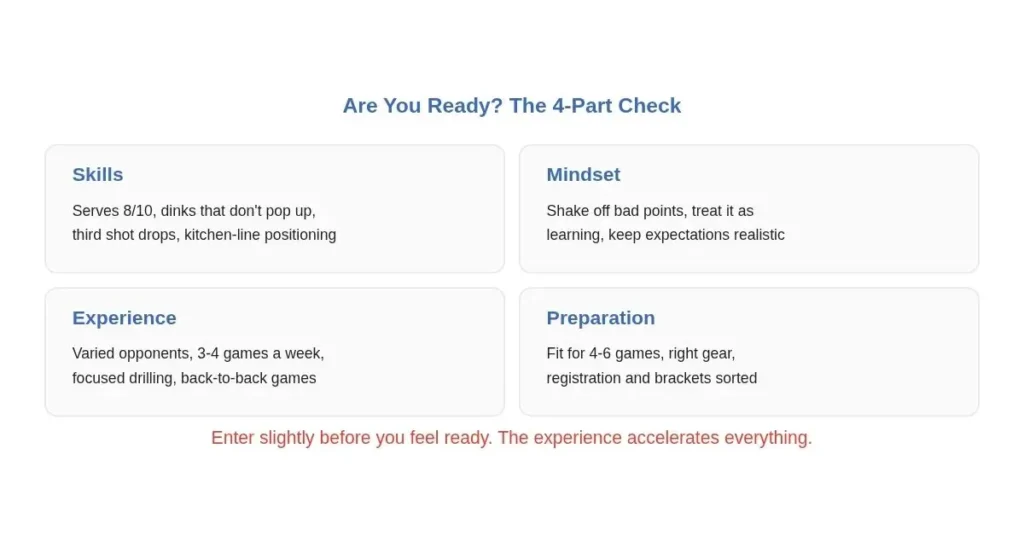
Reliable fundamentals matter more than spectacular plays. You should land serves in bounds at least eight out of ten times and return with similar accuracy. You should be able to dink across the net without popping it up. Your third shot drops do not need to be perfect every time, but you should understand their purpose and attempt them regularly.
Court positioning separates rec players from competitors. You should naturally move to the kitchen line after serving or returning instead of camping at the baseline, and you should recognize when to switch sides with your partner and cover the middle. Rule knowledge counts too. You need to know fault scenarios, service rotation, kitchen violations, line-call etiquette, and timeout rules without hesitation, so an avoidable mistake never costs you a point.
The Right Mindset
Your response to pressure reveals whether you are ready. Can you shake off a bad point and refocus on the next one? Everyone misses easy shots, but dwelling on mistakes all match long is a sign you might want more rec play first. Holding steady when you are trailing shows real mental readiness.
Just as important is your orientation. Players who treat a tournament as a learning opportunity adapt far better than those who see only win or lose. You should feel curious about testing yourself against new opponents, not terrified of losing. And keep your expectations realistic. Your first event is not about medals. It is about experience and finding what to work on. Players who expect to dominate immediately usually leave discouraged.
Match Experience
Playing varied opponents prepares you for tournament dynamics. You want experience against players who hit harder than you, players with tricky spins, and partners with different styles. Exposure to outdoor wind and different court surfaces builds adaptability that rec play alone cannot.
Volume matters more than the occasional marathon session. Three to four games a week over several months builds the muscle memory and endurance tournament formats demand, and you should be able to play several games in a row without falling apart from fatigue. Tournament-ready players also drill, working specific shots systematically rather than only playing full games. If you can do that, you are closer than you think, and the gap between rec play and competing is smaller than it looks from the outside, much like getting good in general.
Get Prepared
Tournament days are more physically demanding than casual sessions. You should be able to play four to six games within a few hours without injury risk or total exhaustion, so basic flexibility and lower-body strength go a long way. Equipment matters more than people expect: a paddle that suits your style, court shoes with good lateral support, and water, snacks, and a towel packed and ready.
Do not overlook the admin side. Understand registration, bracket formats, and check-in before the day. Read every message from the tournament director, arrive with plenty of time, and know whether you need a membership or rating for the event you are entering. Sorting this out in advance removes most day-of stress.
Pick Your Partner
For doubles, your partner shapes the whole experience. Play together enough to understand each other’s tendencies and communicate well during points. Agree on basic strategy and a hand signal or two for poaching and switching, so you have cohesion under pressure rather than confusion. If you are still weighing formats, our guide on singles or doubles first can help you decide which to enter.
Lean on your community too. Players who have competed can answer questions and calm first-tournament nerves, and familiar faces in the crowd make the day less intimidating. Honest self-assessment across all of these dimensions is how you decide, but most players actually benefit from entering slightly before they feel completely ready, because the experience itself accelerates improvement. Start with lower divisions and local events, and once you commit, our first tournament tips walk you through the day itself.
Domande frequenti
How long should you play pickleball before entering a tournament?
Most players are ready after three to six months of consistent play, usually two to three times a week. Prior racket sport experience can shorten that timeline. Focus on skill development and readiness signs rather than an arbitrary number of months.
What skill rating should you have before competing?
You can enter beginner divisions at any level, but most players feel comfortable around a 3.0 to 3.5 rating. Many tournaments also offer unrated divisions built specifically for first-time competitors, so check the division descriptions when you register.
Should you enter singles or doubles for your first tournament?
Doubles is generally recommended for beginners, because partner support reduces pressure and creates learning opportunities. Singles demands far more court coverage and fitness. Mixed doubles is another accessible entry point if you want a gentler first competitive experience.
What happens if you lose your first match?
Most tournaments use double-elimination or pool play, so you will play several matches regardless of how the first goes. Losing early just gives you more time to watch and learn. Every competitor, at every level, loses matches regularly.