

Pickleball emerged in the summer of 1965 on Bainbridge Island, Washington, as an improvised backyard game that would eventually become one of America’s fastest-growing sports. What started as three fathers trying to entertain their bored children has transformed into a global phenomenon played by millions.
Origins
The Beginning
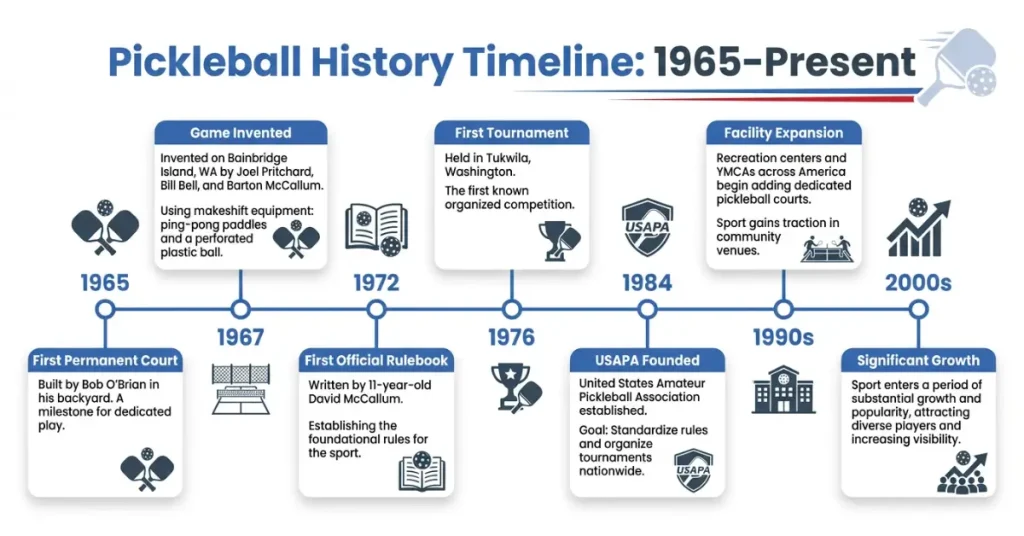
Congressman Joel Pritchard, businessman Bill Bell, and Barton McCallum created pickleball when they returned to Pritchard’s home after a round of golf. Their families were sitting around with nothing to do on a Saturday afternoon.
The property had an old badminton court, but they couldn’t find enough rackets or a complete set of equipment. Instead of giving up, they improvised with ping-pong paddles and a perforated plastic ball. They lowered the badminton net to waist height and began volleying the ball back and forth.
Early Rules
The creators initially played by badminton rules, but these quickly evolved. The ball bounced well on the asphalt surface, so they allowed the ball to bounce. Within days, they developed rules that borrowed elements from badminton, tennis, and table tennis.
The original net height was 60 inches at the sidelines, though it was later standardized to 36 inches at the sidelines and 34 inches at the center. The non-volley zone, now called “the kitchen,” was established to prevent players from dominating at the net with smash shots.
Name
The Dog
The most popular origin story involves the Pritchard family dog, Pickles. According to Joan Pritchard, Joel’s wife, the dog would chase after the ball and run off with it. The game was supposedly named after their cocker spaniel.
However, Joan later admitted in a 1990 interview that the name actually came first. The game was named after the “pickle boat” in crew, where oarsmen were chosen from the leftovers of other boats. The dog was actually named after the game, not the other way around.
Development
First Court
By 1967, Bob O’Brian constructed the first dedicated pickleball court in his backyard. Joel Pritchard built a court at his home in 1972. These permanent courts helped establish consistent playing dimensions and rules.
The court dimensions were set at 20 feet wide by 44 feet long, the same size as a doubles badminton court. This compact size made pickleball ideal for recreational facilities with limited space.
Rule Codification
Barton McCallum’s son, David McCallum, wrote the first official rulebook in 1972. He was 11 years old at the time. The early rules were simple and player-friendly, emphasizing accessibility over complexity.
The sport incorporated the two-bounce rule, requiring the ball to bounce once on each side before volleys were allowed. This rule slowed the game down enough to make it accessible to players of all ages and skill levels.
Growth
Early Spread
Pickleball remained a regional Pacific Northwest activity through the 1970s. The sport spread through physical education teachers who learned about it and introduced it to their schools.
The first known pickleball tournament was held in 1976 in Tukwila, Washington. This event attracted players from across the state and demonstrated the sport’s competitive potential.
National Organization
In 1984, the United States Amateur Pickleball Association (USAPA) was formed to perpetuate the growth and advancement of pickleball. The organization standardized rules and began sanctioning tournaments.
The association published an official rulebook and established a national tournament structure. This organizational framework helped pickleball transition from a backyard pastime to a legitimate sport.
Expansion
Equipment Evolution
Early players used wooden paddles, often handmade in home workshops. The first composite paddles appeared in the 1980s, offering improved performance and durability.
Modern paddles use advanced materials like graphite, carbon fiber, and polymer cores. These technological improvements have made the game faster and more dynamic while maintaining its accessibility.
Facility Adoption
Recreation centers and retirement communities were early adopters of pickleball. The sport’s low impact and social nature made it particularly popular among older adults.
By the 1990s, YMCA facilities across the country began dedicating courts to pickleball. Schools added pickleball to their physical education curricula because of its easy learning curve and minimal equipment requirements.
Modern Era
Explosive Growth
The 2000s marked a turning point for pickleball. The number of players began doubling every few years. According to the Sports & Fitness Industry Association, pickleball had 4.8 million players in the United States by 2021.
The COVID-19 pandemic accelerated growth dramatically. Outdoor, socially distanced activities became attractive, and pickleball courts were quickly converted from underutilized tennis facilities.
Professional Scene
The first professional pickleball tours emerged in the 2010s. The Association of Pickleball Professionals (APP) and Professional Pickleball Association (PPA) now offer substantial prize money and televised events.
Major sponsors from tennis and other sports have invested in pickleball. Professional players can now earn six-figure incomes through tournament winnings, sponsorships, and teaching.
International Reach
While still predominantly American, pickleball has spread to over 70 countries. Canada, Spain, France, and India have particularly active pickleball communities.
The International Federation of Pickleball was established to govern the sport globally and promote international competition. The sport continues pursuing Olympic recognition.
Legacy
Founders’ Impact
Joel Pritchard served in Congress and as Lieutenant Governor of Washington. Bill Bell was a successful businessman. Barton McCallum worked in the printing industry. None of them could have anticipated their backyard invention would impact millions of lives.
The three founders remained involved in pickleball throughout their lives, promoting the sport and attending tournaments. Their emphasis on fun, accessibility, and inclusivity remains central to pickleball culture today.
Cultural Phenomenon
Pickleball represents more than athletic competition. The sport has created communities, improved health outcomes for older adults, and provided intergenerational connection opportunities.
From three bored families on a Saturday afternoon to a sport played in schools, retirement communities, and professional arenas, pickleball’s journey reflects American innovation and the universal appeal of simple, enjoyable recreation.
FAQs
Why did the founders choose badminton court dimensions?
The existing badminton court on Pritchard’s property dictated the 20×44-foot playing area, becoming permanent when players found it created ideal rally length. This accidental dimension proved perfect—larger than ping-pong for movement, smaller than tennis for accessibility, creating the “Goldilocks” court size that drives pickleball’s multigenerational appeal today.
What happened to the original Bainbridge Island court?
The first dedicated pickleball court built in 1967 at Bob O’Brian’s property no longer exists in its original form. However, Bainbridge Island now celebrates its pickleball heritage with multiple modern courts and occasional commemorative events honoring the sport’s birthplace, though no official museum or historical marker exists at the actual location.
What role did Joel Pritchard’s political career play?
Congressman Pritchard strategically demonstrated pickleball at campaign events throughout the 1970s, using it as constituent engagement rather than pure recreation. His position provided legitimacy and publicity that grassroots inventors couldn’t access, essentially giving pickleball congressional sponsorship during its vulnerable early years when most backyard inventions fade into obscurity.
Why wasn’t pickleball patented by the inventors?
The three founders deliberately chose not to patent the game, believing widespread adoption mattered more than profit. This decision mirrors volleyball’s history but contrasts with modern sports IP protection. Their open-source philosophy enabled rapid rule modifications, equipment innovations, and global spread without licensing barriers that might have strangled growth.
When did professional pickleball become financially viable?
Professional viability emerged surprisingly recently—2021’s Major League Pickleball launch marked the turning point. Before that, top players earned minimal prize money, relying on coaching and equipment sponsorships. The 2024 merger creating $260,000 average earnings means professional pickleball is only three years old as a legitimate full-time career path.
