

A ball comes screaming at you at the kitchen line. In a split second you have to choose: block it soft or counter it back with pace. That one decision often wins or loses the rally. Here is how to make the right call every time.
The Split-Second Choice
You are standing at the kitchen line. The ball is coming at you fast, drilled from the baseline. In that split second, you have to make a choice. Do you block it softly or counter it back with pace? That decision often decides the rally before the ball even reaches your paddle.
Many players default to one response every time. Some try to counter everything, which leads to pop ups and errors when the contact point is low. Others always block, missing chances to seize control when the ball sits in their strike zone. Neither approach works consistently against good opponents.
Pickleball at the net is a game of constant adjustments. The best players read the ball, their positioning, and their opponent’s intent in a fraction of a second. They do not force a counter when a block is smarter. They do not passively block when a counter would end the point. Whether to block or counter in pickleball comes down to five practical steps that turn this instinct into a reliable skill.
Contact Point Height
The first thing to judge is the height of the ball when it meets your paddle. This is the single most important factor in your decision.
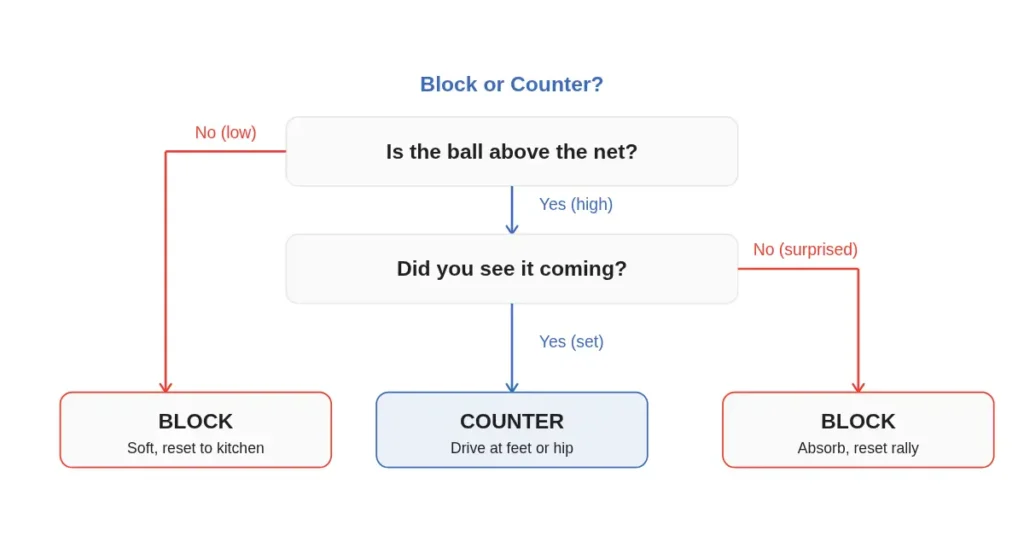
If the contact point is above the net, you have the green light to counter. A high contact point, especially around shoulder height or higher, gives you the leverage to drive the ball back with power and accuracy. You can get your weight into the shot and put your opponent on defense.
But if the ball is at net level or below, you should almost always block. A low contact point robs you of that leverage. If you try to counter from here, you will likely hit the ball into the net or pop it up for an easy put-away. Think of it this way: a high ball is an opportunity to attack, a low ball is a problem to manage. When the ball is low, your goal is simply to neutralize the pace. Use a soft block to drop the ball back into the kitchen and reset the point.
Were You Ready?
Now ask a second question: did I see this coming? Your level of anticipation changes everything about how you should respond. Many players ignore this factor, but it can make or break your shot.
When you see the speed-up coming and you are set in your stance, you have the advantage. Your feet are planted. Your paddle is ready. Your eyes tracked the ball from the moment your opponent started their swing. In that situation, you can meet the ball with a counter. You have the time and balance to drive it back with purpose.
But what happens when you get caught off guard? Maybe your opponent disguised the shot. Maybe the ball came faster than you expected. When you are surprised, your body tenses up, your feet get stuck, and your timing is off. Trying to counter in that state is a recipe for a pop up or a miss. Instead, a block is your safest and smartest move. It lets you absorb the pace and keep the rally alive. You are not trying to win the point with one shot. You are resetting so you can get back into it.
Should I Block or Counter a Speed-Up?
Counter only when both are true: the ball meets your paddle above the net AND you saw it coming and are balanced. If the contact point is low, or the speed-up surprised you, block it soft into the kitchen instead. A high, expected ball is your green light to attack. A low or surprising ball is your cue to absorb the pace and reset the rally.
Execute the Counter
You identified the contact point as high and you are set. Now execute. A successful counter is not wild swinging. It is control and precision. When the ball meets your paddle above the net, use a short, compact swing. Keep your backswing small and your follow-through controlled. Drive through the ball with a firm wrist and a stable paddle face.
Your goal is to send the ball back with the same speed they gave you, but aimed at a tougher spot. Aim for their feet or their hip. This forces them to hit up, taking away their next speed-up. A high contact point lets you step into the shot and transfer your weight forward, adding power without sacrificing accuracy.
There is a strategic layer too. If your opponent is comfortable ripping drives from the baseline, counter the ball back to their baseline corner instead of blocking soft and drawing them in. It forces them to generate their own power again, which is more tiring and error-prone for them. A well-placed counter turns a defensive situation into an attacking one in a single stroke.
Execute the Block
The ball is low and you are a bit late. It is block time. A good block is not a punch or a swing. It is a soft redirect. Your goal is to steal the pace and drop the ball into the kitchen.
Start with your grip. Loosen it to about a 2 or 3 out of 10 on the tension scale. A death grip makes the ball bounce off your paddle like a rock. Instead, let the paddle act like a cushion that absorbs the energy. Next, angle the paddle face slightly upward. This is critical. If your paddle is flat or pointing down, you will hit the ball into the net. A slight upward angle clears the tape and lands softly in the kitchen. You are not driving the ball, just giving it a lift.
Make contact close to your body. Do not reach out and stab at it. Bringing the contact point in tight gives you more control and a quieter paddle face. Your block should look and feel simple: a short, compact movement that neutralizes the speed and resets the rally. This is how you survive a firefight at the net. You absorb the bullet and let it drop.
Drill the Decision
Knowing the theory is not the same as executing it in a real rally. You need to practice this decision under pressure so it becomes automatic.
Try this drill with a partner. Stand at the kitchen line while your partner feeds you speed-ups from the baseline. Your job is to make the block or counter decision based on everything covered: look at the contact point height, feel your readiness, then execute. Do not overthink it. Just react.
Start slow. Let your partner feed shots that are clearly high or clearly low to build confidence. As you improve, have them mix up the speed and placement and throw in shots that catch you off guard. Make it feel like a real game. The goal is to train your eyes and body to work together so you see the ball and know instantly whether to block or counter. Run this drill for ten minutes during your next practice session and it will pay off faster than you think.
FAQ
When should you counter a speed-up in pickleball?
Counter only when two things are true at once: the ball reaches your paddle above net height, and you saw the speed-up coming so you are set and balanced. A high, expected ball gives you the leverage and time to drive it back at your opponent’s feet or hip.
When should you block instead of counter?
Block when the ball is at net level or below, or when the speed-up catches you by surprise. A low contact point removes your leverage, and being caught off guard ruins your timing. In both cases a soft block that absorbs the pace and drops into the kitchen is the smarter, safer play.
How do you execute a good block volley?
Loosen your grip to about a 2 or 3 out of 10 so the paddle cushions the ball instead of rebounding it. Angle the paddle face slightly upward to clear the net, and make contact close to your body with a short, quiet movement. You are redirecting the pace, not driving the ball.
How do you practice the block or counter decision?
Have a partner feed speed-ups from the baseline while you stand at the kitchen line. React to each one by reading the contact height and your readiness, then block or counter. Start with clearly high or low feeds, then mix in surprises. Ten minutes a session trains the decision until it is automatic.