

You want a number before you spend money on lessons. Fair enough. Most beginners get competent in 6 to 12 lessons, but the real answer depends on what you do between them. Here is the honest timeline and what actually speeds it up.
How Many Lessons Until You Get Good?
Most beginners become competent after 6 to 12 lessons, though your timeline depends on athletic background, practice frequency, and learning approach. Players with racquet sport experience often progress faster, while complete beginners usually need the full dozen sessions to build consistent fundamentals. The real difference-maker is not the number of lessons. It is what you do on the court between them.
The Foundation
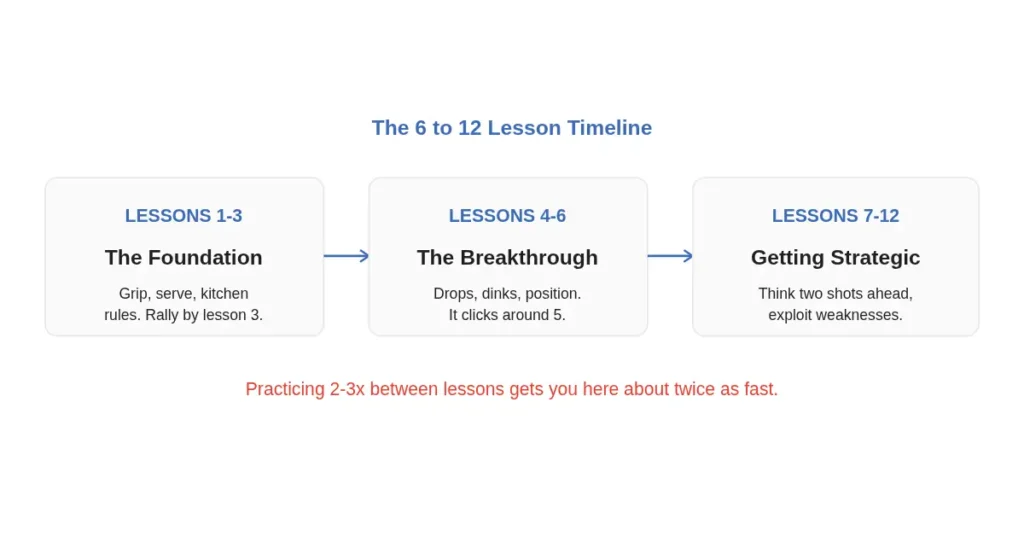
Your first three sessions establish the basics. You will learn proper grip, basic serve mechanics, and the non-volley zone rules that confuse every newcomer. Expect to feel awkward. Your paddle will seem too light, the ball too bouncy, and the court surprisingly compact. Most players can rally consistently by lesson three, though your shots will not have much control or strategy behind them yet. This is the how to play pickleball phase, where everything is new and nothing feels automatic.
The Breakthrough
Lessons four through six focus on shot variety and court positioning. You will add drop shots, lobs, and dinks to your game while learning when to stay back versus when to rush the kitchen line. Your muscle memory starts kicking in here, and those forced, robotic movements from earlier sessions begin feeling natural. Many players hit a breakthrough moment around lesson five where everything suddenly clicks.
Getting Strategic
Lessons seven through twelve are about positioning and strategy. You are not just hitting the ball anymore. You are thinking two shots ahead, anticipating returns, and exploiting weaknesses in your opponent’s game. Most beginner lesson plans wrap up around this point because you have developed enough to keep improving through regular play and self-directed practice.
What Speeds It Up
Three factors decide how fast you move through that timeline.
Previous experience matters most. Tennis, badminton, and table tennis players shorten the curve significantly because hand-eye coordination, footwork, and court awareness transfer directly. Complete beginners need more time building those athletic fundamentals before tactical concepts make sense.
Practice frequency is the lever most people ignore. One lesson a week with no practice in between delivers minimal results. Players who practice two to three times between lessons progress roughly twice as fast, because your brain needs repetition to lock in new motor patterns. Weekly lessons alone do not give you enough touches on the ball.
Quality of instruction is the third factor. Group classes work well for absolute beginners learning rules and basic strokes, but private instruction accelerates things once you understand fundamentals. A skilled coach spots your specific weaknesses and builds targeted drills, while group settings make everyone work on the same generic skills.
What Good Means
Good is subjective. Some players feel competent when they can sustain a 10-shot rally. Others do not feel skilled until they are winning local events. A realistic benchmark for beginner success: consistent serves, controlled dinks, knowing when to attack versus reset, and fewer than five unforced errors per game.
Most players also stall around lesson eight, when the mechanics are solid but strategy is still fuzzy. You can hit every shot type, yet you lose to players who seem less athletic but make smarter decisions. Breaking through means shifting your focus from shot execution to game awareness, understanding not just how to dink, but when dinking is the right tactical choice. If you feel stuck there, the fix is usually more focused practice, not more lessons.
What Matters Most
Here is the truth that no lesson package will tell you: pickleball rewards consistent practice more than expensive instruction. Those 6 to 12 lessons give you the tools. What you build with them depends entirely on how much court time you log after the instructor stops watching.
Play open play sessions between lessons to face different styles and situations a coach cannot replicate. Record your games, because footwork mistakes and late paddle preparation that feel correct in real time look obviously wrong on video. And drill with purpose. If your backhand dink keeps popping up, spend 15 minutes on only that shot before open play. Most players discover they are good enough to genuinely enjoy the game long before they are objectively skilled by competitive standards.
Häufig gestellte Fragen
Was sind die beiden Arten von mentalen Fehlern im Pickleball?
Erstens hast du beim Schwung überhaupt kein Ziel, dein Gehirn bekommt keine klare Anweisung. Zweitens wählst du ein Ziel ohne Spielraum, z. B. direkt an die Grundlinie oder Seitenlinie. Beides ist ein Entscheidungsproblem, kein mechanisches Versagen.
Warum zielen Profis auf die Mitte statt auf die Linien?
Profis wissen, dass jeder Schlag natürliche Schwankungen zwischen Ziel und Balllandung hat. Auf die Linien zu zielen bedeutet, dass die Hälfte der Schläge aus ist. Ein paar Fuß innerhalb der Linien zu zielen lässt diese Schwankungen atmen und erzeugt trotzdem Gewinnschläge.
Wie behebe ich mentale Fehler im Pickleball schnell?
Zwei Schritte. Erst ein konkretes Ziel vor jedem Schlag wählen. Dann prüfen, ob das Ziel genug Puffer hat, indem man fragt: Landet mein Schlag zwei Fuß daneben, bleibt er im Spiel? Wenn nicht, Ziel verschieben. Das lässt sich sofort ohne mechanische Änderungen anwenden.
Sind mentale Fehler leichter zu beheben als mechanische Fehler?
Ja. Mechanische Fehler erfordern das Zerlegen deines Schwungs, das Einprägen neuer Bewegungsabläufe und Hunderte Wiederholungen über Wochen oder Monate. Mentale Fehler lassen sich durch eine schnelle Entscheidungsanpassung vor dem nächsten Punkt korrigieren. Behebe zuerst mentale Fehler für den größten Nutzen.