

The best pickleball training aid for most players is the Qyntelix Sweet Spot Paddle, which sharpens contact precision faster than standard match play can.
This guide covers seven top training tools — from solo drilling options to automated launchers — matched to different skill levels, available space, and practice goals. Whether you’re a beginner eliminating errors or a competitive 4.0 looking to lock in advanced technique, something here will genuinely move your game forward.
Best Overall Training Aid
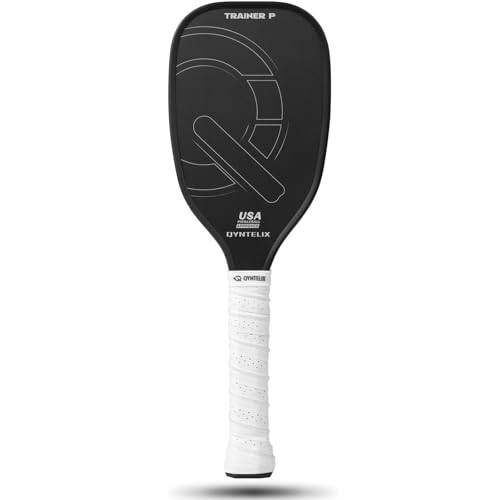
Quick Take
Forces you to make clean contact every time. The smaller hitting surface exposes lazy form fast — in a good way. Consistent reps with this genuinely retrain your muscle memory.
Key Features
- 57 sq in hitting surface
- T700 carbon fiber face
- 16mm honeycomb core
| ✅ Pros | ❌ Cons |
|---|---|
| Builds precise contact habits | Not for actual match play |
| Works at any skill level | Feels awkward at first |
Best For
Intermediate players who keep hitting off-center shots they shouldn’t. Also solid for beginners who want to build real habits early instead of grooving bad ones from the start.
Runner-Up

Quick Take
A solid solo training tool that actually handles real shots — not just gentle pats. The adjustable angle keeps things versatile enough to work on multiple shot types without needing a partner.
Key Features
- 6×6 ft full-size frame
- Angle adjusts: 30°–90°
- Folds to 3″ thick for storage
| ✅ Pros | ❌ Cons |
|---|---|
| Handles all shot types | Needs a lot of open space |
| Folds flat for easy storage | Heavy for solo transport |
Best For
Players who train alone a lot and want realistic ball return without a practice partner. Great for households with multiple players at different levels who all share the same equipment.
Budget Pick

Quick Take
The go-to for quiet indoor training. They bounce realistically enough to keep your mechanics honest and won’t damage anything. Simple, practical, and they last surprisingly long.
Key Features
- 2.91″ dia, 0.847 oz
- ~60 dB noise level
- 85% of regulation bounce
| ✅ Pros | ❌ Cons |
|---|---|
| Near-silent indoor practice | Not match-ready feel |
| Durable and damage-free | Lighter than real balls |
Best For
Apartment dwellers, beginners, and anyone who needs to practice indoors without the noise. Also great for families with kids just getting into the sport.
Best Advanced Training Aid

Quick Take
A laser-focused topspin tool that removes the guesswork. Guided reps lock in the right swing path fast. If topspin is your weak spot, this closes that gap quicker than most things will.
Key Features
- Hitting zone: 28″–42″
- Weighs 14.5 lbs, 67″ tall
| ✅ Pros | ❌ Cons |
|---|---|
| Teaches correct spin mechanics | Very narrow, specific use |
| Adjusts for all skill levels | Takes time to set up |
Best For
Intermediate to advanced players whose topspin breaks down under pressure. Also useful for ex-tennis players who want to translate existing spin muscle memory into pickleball-specific mechanics.
Best Ball Machine

Quick Take
This is the real deal for solo drilling. Programmable sequences, consistent feeds, app control — it’s like having a coach who never gets tired and always hits the same spot.
Key Features
- 110-ball capacity
- Speed: 10–70 mph
- App: 12 drills + custom
| ✅ Pros | ❌ Cons |
|---|---|
| Highly consistent ball feeds | Not for casual players |
| Full app-based drill control | Needs dedicated practice space |
Best For
Serious competitors and coaches who need reliable, programmable practice. If you’re training multiple times a week and want a machine that actually keeps pace with your development, this delivers.
Best Budget Ball Machine

Quick Take
Does what a basic launcher should — feeds balls consistently enough to build reps. It’s not fancy, but it works. A solid entry point for anyone getting into automated solo practice.
Key Features
- 19-ball capacity (expandable)
- 4-sec feed; 4 speeds, 3 angles
- Battery, AC, or power bank
| ✅ Pros | ❌ Cons |
|---|---|
| Multiple power source options | Feed consistency is limited |
| Easy to move and store | Basic features only |
Best For
Beginners and recreational players who want automated ball feeding without committing to a full pro-level machine. Works well if you’re just starting out with solo drilling and want something functional.
Best Training Ball

Quick Take
Clever spin-revealing design that teaches you something every time you hit. You start seeing spin differently after just a few sessions. Simple idea with genuinely useful real-world impact.
Key Features
- 2.9″ dia, 0.85 oz (24g)
- 26 holes
- Two-color halves
| ✅ Pros | ❌ Cons |
|---|---|
| Makes spin instantly visible | Not for actual match play |
| Extra durable construction | Only useful for spin training |
Best For
Players at any level who struggle to read spin during live play. Especially useful if you keep getting caught off guard by opponent spin shots or want to start developing spin-based strategies.
Buying Guide
Your Skill Level
Beginners need consistency-building tools like training paddles and foam balls. Intermediate players benefit from rebounders and basic ball machines. Advanced players should consider specialized equipment like the TopspinPro for technique refinement.
Available Space
Measure your practice area before buying. Training paddles work anywhere. Rebounders need 12×20 feet minimum. Ball machines require similar space plus clearance for ball collection.
Indoor vs Outdoor
Indoor training demands quiet equipment. Foam balls produce 90% less noise than regulation balls. Outdoor setups handle full-size rebounders and any ball type without neighbor concerns.
Budget Considerations
Start small and expand. A $35 training paddle delivers immediate results. Add foam balls for $13. Budget $200+ for rebounders or entry-level ball machines. Professional setups run $500+.
Portability Needs
Fold-flat rebounders fit in car trunks. Lightweight ball machines enable location changes. Fixed installations provide stability but require dedicated space. Consider how often you’ll move equipment.
Mistakes
Advanced Equipment
Players often purchase expensive ball machines before mastering basic technique. Start with training paddles and foam balls. Build fundamentals before investing in automated equipment.
Space Limitations
Rebounders need room for ball collection and player movement. Measure twice, buy once. A cramped practice area creates frustration and limits training effectiveness.
Footwork Neglect
Players focus on shot technique while neglecting movement skills. Agility ladders and cones cost under $20 but dramatically improve court coverage and shot preparation.
Final Verdict
The Qyntelix Sweet Spot Paddle is the clear top pick — not because it’s fancy, but because inconsistent contact is the most universal problem in pickleball, and this directly fixes it. Nothing else in this roundup works for as broad a range of players in as many settings. Start here. Every other tool in this guide makes more sense once you’ve got the fundamentals dialed in.
FAQs
Do foam balls teach bad habits?
No, when used correctly. The slight weight difference doesn’t affect stroke mechanics during technique training. Switch to regulation balls periodically for game-speed practice to maintain proper feel and timing for match situations.
What’s the ideal rebounder angle for dinking?
Set your
Can training aids fix my return of serve issues?
Absolutely. Ball machines with variable spin settings let you practice returns against different serve types. Record yourself to identify and correct mechanical flaws in your motion.
Do ball machines help defensive players?
Yes, tremendously. Program machines to deliver fast shots at body height to practice blocking and resets. Variable placement helps develop lateral movement and quick hands. Defensive specialists benefit from consistent, aggressive feeds for reaction training.
Do professional players use training aids?
Many top players like Ben Johns and Anna Leigh Waters regularly use ball machines, specialized training balls, and footwork equipment.
