

The best pickleball machine for most more serious players is the Titan ACE.
This guide is for anyone trying to pick the right machine without getting lost in feature lists or buying more than they need. You can trust it because it focuses on what actually changes practice—control, consistency, portability, battery life, and which machine fits your level.
Best Overall Ball Machine

Quick Take
If you want a machine that pushes your game instead of just feeding balls, this is the one. It gives you a lot of control and keeps practice feeling intentional, not random.
Key Features
- Speed range: 10-70 mph
- Ball capacity: 110 balls
- Weight: 39 lbs empty, 47 lbs full
- App control with 12 preset drills via Bluetooth
- Internal oscillation system
- Battery life: ~2 hours
- Topspin and backspin capabilities
- Removable hopper design
| ✅ Pros | ❌ Cons |
|---|---|
| Feels very game-like | Battery isn’t long |
| Lots of drill control | More to learn at first |
Best For
Players who practice with purpose and want drills that feel closer to real points. Also a smart fit for coaches or groups who need one machine to do a lot.
Best Value Ball Machine
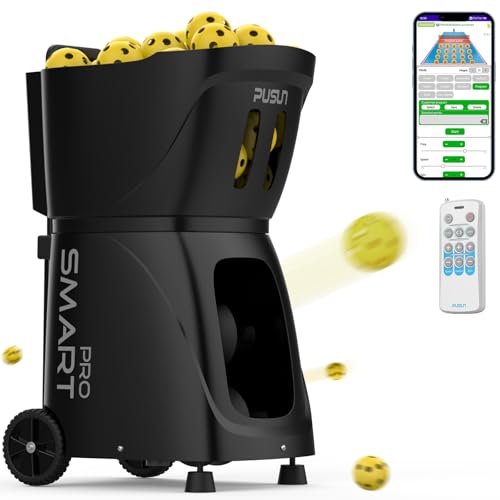
Quick Take
This one makes sense if you want smart features without going overboard. It covers the basics well, gives you useful variety, and feels like a solid step up from entry-level machines.
Key Features
- Speed range: 20-75 km/h (approximately 12-47 mph)
- Ball capacity: 85 balls
- Weight: ~30 lbs
- App control with 20 programmable points and 10 training modes
- Random drill mode
- Horizontal and vertical oscillation
- Battery life: 4-6 hours
- Power: 100W
| ✅ Pros | ❌ Cons |
|---|---|
| Good drill variety | Top speed is limited |
| Long battery life | Less room to grow |
Best For
Intermediate players who want more than simple feeds but don’t need the most advanced setup. Good if more than one person will use it and solo practice is part of your routine.
Best Ball Machine for Beginners

Quick Take
Straightforward, easy to handle, and not intimidating. It does the simple stuff you actually need when you’re learning, which is kind of the whole point for a first machine.
Key Features
- Speed range: 6-31 mph (10-50 km/h)
- Ball capacity: 50 balls
- Weight: 22 lbs (10 kg)
- Control: Remote and app
- Remote distance: 39 feet (12 meters)
- Built-in oscillation
- Feed frequency: 1.5-10 seconds
- Elevation angle: 20°-60°
- Battery life: 2-4 hours
- Retractable trolley handle and large wheels
| ✅ Pros | ❌ Cons |
|---|---|
| Easy to use | Small ball capacity |
| Light and portable | Not for hard hitters |
Best For
Beginners who want regular reps without fuss. Also a good match for families, kids, or anyone who wants simple solo practice and doesn’t care about fancy extras.
Best Budget Ball Launcher

Quick Take
This is a basic launcher, plain and simple. It won’t do much beyond steady feeds, but that’s enough if you just want to get moving and work on timing.
Key Features
- Adjustable height: 1-8 feet
- Range: 17-33 feet
- Ball holder capacity: 19 balls per holder
- Swivel base for side-to-side movement
- Feed interval: 4 seconds (fixed)
- Adjustable spin (left and right wheels)
- Multiple power options (D batteries, AC adapter, power bank)
- Tripod compatible (standard camera tripod mount)
- Weight: Approximately 7 lbs
| ✅ Pros | ❌ Cons |
|---|---|
| Very easy to carry | Fixed feed timing |
| Simple to get started | Limited training depth |
Best For
Absolute beginners, casual players, and families who want the simplest way to start machine practice. Fine for light use, but most improving players will outgrow it pretty quickly.
Best Traditional Ball Machine

Quick Take
If you’d rather skip apps and just turn the thing on, this is the appeal. It’s dependable, simple to run, and built for players who want practice without extra setup.
Key Features
- Speed range: 10-60 mph
- Ball capacity: 125-135 balls
- Weight: 35 lbs
- Feed rate: 2-12 seconds
- Topspin and backspin
- Random horizontal oscillation
- Manual elevation crank: 0-50 degrees
- Remote control included
- Battery life: 2-4 hours
- 8-inch wheels for easy transport
| ✅ Pros | ❌ Cons |
|---|---|
| Reliable and simple | No app features |
| Big ball capacity | Less drill variety |
Best For
Players, clubs, and groups that want a machine anyone can use without a learning curve. Great if you value reliability more than fancy controls or custom drill building.
Buying Guide
Skill Level
Beginners need consistent ball feeds for developing stroke mechanics. Simple manual controls work best at this stage—think JP02 or A11N machines that just deliver reliable shots.
Intermediate players benefit from speed variety, spin options, and oscillation. You’re ready for machines like the PUSUN that challenge you without overwhelming complexity.
Advanced players require programmable drills, variable speeds, and multiple spin options. The Titan ACE provides the customization needed for serious training.
Speed Range
Different shots need different speeds. Dinks come at 10-20 mph, drives reach 40-50 mph. Your machine should cover the range for shots you actually practice.
Most quality machines offer 10-60 mph, handling nearly every game situation. Avoid machines topping out below 40 mph unless you’re just starting out—you’ll outgrow them fast.
Ball Capacity
Larger hoppers mean fewer interruptions. Here’s what works:
50-60 balls fit beginners doing 15-20 minute drills. 80-100 balls suit intermediate players wanting 30-minute sessions. 110+ balls work for advanced training or coaching groups.
You’ll still collect balls after each hopper, but larger capacities keep you drilling longer.
Portability
Consider weight (22-48 pounds), size (trunk space?), wheel quality, and handle design. Small car? Limited storage? Prioritize lightweight, compact machines.
Control Type
Manual controls (Lobster, JP02) are simple, reliable, and multi-user friendly. No connectivity issues, fewer features.
App-controlled machines (Titan ACE, PUSUN) offer extensive customization and preset drills. Learning curve required, smartphone dependent.
Battery Life
Check what’s included. Most machines use rechargeable batteries with 2-4 hour life. Replacement batteries run $200-300, so factor that into your budget.
Mistakes
Don’t practice only strengths. Your forehand might feel great, but games expose weaknesses. Spend more time on shots you’d rather avoid.
Footwork matters. Don’t just stand and hit. Move your feet, maintain proper positioning, practice recovering after each shot.
Be consistent. Three 30-minute weekly sessions beat one 90-minute marathon. Consistency builds muscle memory better than cramming.
Final Verdict
The Titan ACE is the best pickleball machine overall. It’s the strongest fit for serious players who want practice to feel focused, flexible, and closer to real play—not just repetitive ball feeds.
If you’re brand new, a simpler machine can still be enough, but if you want one you can grow into, this is the clear pick.
FAQs
Can machines simulate specific opponent styles?
Advanced app-controlled machines let you program shot sequences mimicking opponents’ patterns. Create custom drills replicating that player who always hits deep backhands or aggressive cross-court drives you struggle with during league matches.
How loud are pickleball machines during use?
Most machines produce 60-75 decibels—similar to normal conversation or background music. The ball-feeding mechanism and motor create moderate noise that’s acceptable outdoors but might disturb neighbors in quiet indoor facilities or residential areas.
Can machines help seniors with slower reflexes?
Definitely. Start with slow, consistent feeds that let seniors groove strokes without rushed movements. Gradually increase speed as confidence builds. Machines provide judgment-free practice that’s less intimidating than keeping up with younger players.
Do machines improve my serve return game?
Significantly. Set machines for deep, fast balls mimicking serves. Practice positioning, timing, and return placement repeatedly. You’ll develop automatic responses that translate directly to competitive play when facing actual serves from opponents.
Should I buy extended warranties on machines?
Consider it for machines over $800. Extended warranties covering mechanical failures and battery replacement provide peace of mind. Read coverage details carefully—some exclude normal wear items like wheels and hoppers.
Do competitive players use machines regularly?
Yes, most serious competitive players incorporate machine training weekly. They use machines for specific skill refinement, conditioning, and maintaining consistency between tournaments. It’s standard practice at higher competitive levels.
Can I rent machines before buying one?
Some specialty retailers and clubs offer rentals or demo programs. Try before buying when possible, especially for premium models. Weekend rentals typically cost $50-100 and help you determine which features you’ll actually use.
How do I sell my used machine later?
Clean it thoroughly, include all accessories, and document maintenance history. List on pickleball Facebook groups, Craigslist, or eBay. Expect 40-60% of original price for well-maintained machines. Demand stays strong in growing pickleball communities.