

Singles pickleball is a different animal. No partner, no safety net, and every error is yours alone. These three repeatable plays give you a clear plan for every point: the serve, the approach, and the return. Memorize them and start winning.
A Different Sport
If you have only played doubles, singles pickleball can feel like a completely different sport. The court suddenly looks enormous, and the pace of play feels relentless.
In doubles, you have a partner to cover half the court. You can cheat a little toward the middle, gamble on a poach, or rely on your teammate to clean up a mistake. None of that exists in singles. It is just you, your opponent, and the entire court. Every shot matters, and every error is yours alone.
The points end fast, often within three or four shots. There is no time for long, patient rallies like you see in doubles. This speed makes positioning and decision making absolutely critical. You cannot afford to hit a weak shot and hope your partner bails you out. If you leave the ball short or in the middle, your opponent will attack it immediately.
The margin for error is razor thin. But that intensity is also what makes singles so addictive. It forces you to improve your footwork, your shot selection, and your mental toughness. You learn exactly where your game stands.
To succeed, you need pickleball singles strategy plays to memorize. You cannot just react and hope for the best. You need specific patterns that give you control of the court.
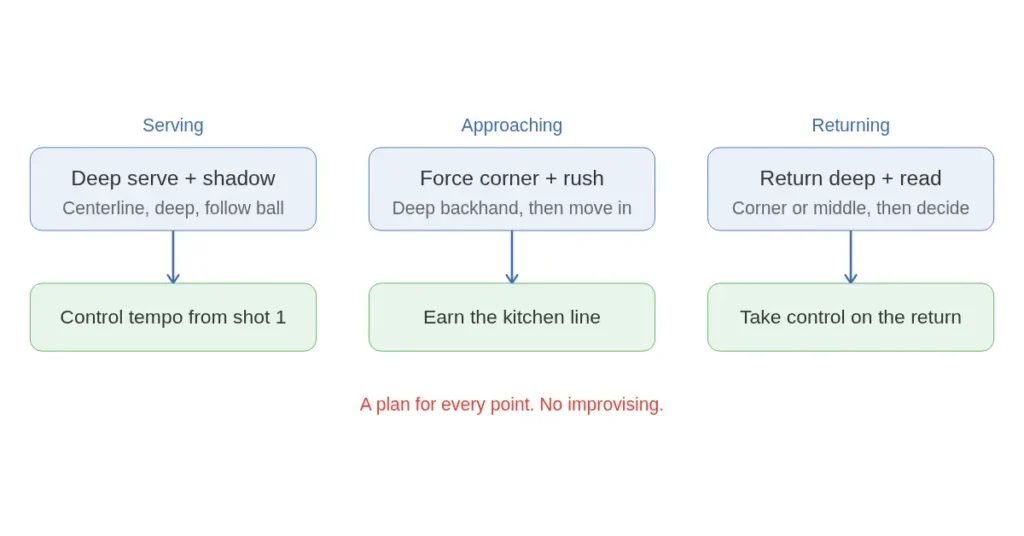
Deep Serve and Shadow
Most players treat the serve like a handshake. A polite way to start the point. In singles, that mindset gets you beat. Your serve is your only chance to dictate the action before your opponent even touches the ball.
The key is serving from near the centerline. This does two things. It limits the angles your opponent can hit on the return, and it puts you in a perfect spot to move toward the ball after you serve. You want to cut off the court, not chase it.
Depth matters more than power here. A hard serve that lands short gives your opponent an easy attack. A deep serve that barely clears the net forces them to stay back and hit up. That split second of hesitation is all you need to take control.
Once you serve, shadow the ball. That means following its path as you move toward center court. If you serve down the line, shift that direction. If you serve to the middle, stay central. You are not waiting to see what happens. You are anticipating and cutting off options.
Mix up your placement too. Go down the line, then to the body, then out wide. When your opponent cannot guess where the serve is going, they cannot set up for a strong return. This serve strategy sets the tone for the whole point.
Forcing Shot and Net Rush
The golden rule in singles pickleball is simple. Control the kitchen line, and you control the point. But you cannot just sprint to the net and hope for the best. If you rush in without setting it up, you will get passed 9 times out of 10.
Start by hitting a deep forcing shot into the corners. Aim for your opponent’s backhand side. Most players are weaker there, especially when they are stretched wide. A ball that lands deep in the corner limits their time to react. They will either pop up a weak return or give you a short ball.
That is your cue to move. Rush the net the moment you see them off balance or reaching for the ball. Do not hesitate. That half-second of doubt is all they need to recover and hit a clean passing shot.
As you close in, stay balanced and face your opponent. Keep your paddle up and ready. They will try to hit past you, either down the line or cross court. Your job is to anticipate that passing shot and volley it back into the kitchen.
Once you are at the net with them pinned deep, the point is yours to finish. One warning: avoid drop shots when your opponent is still on the baseline. It feels like a clever play, but good players will read it early, attack it, and send a passing shot right past you. Stick to deep drives until they are at the net with you.
Return Decision Tree
Your return of serve is your first chance to take control of the point. A weak, floating return gives your opponent exactly what they want: time to set up and attack. But a strong, deep return changes everything.
Your goal on the return is simple. Hit it deep to one of the corners or straight down the middle. The corners force your opponent to move laterally, and the middle eliminates their angle options. Either way, you want that ball landing near the baseline.
Now comes the decision part. You have to read your opponent’s position and react instantly.
If they are still hanging back near the baseline after their serve, move forward. Approach the net and cut off their angles. They are on defense, and you want to keep them there.
If they have already moved up to the kitchen, you have three options. Hit a hard passing shot down the line or cross-court. Drop the ball softly at their feet to force them to hit up. Or float a lob over their head, but only if you are confident in your accuracy. A bad lob in singles is a death sentence.
As you move up after your return, follow the path of the ball. If you returned cross-court, shift slightly toward that side. This closes off the line and forces your opponent to hit through your strongest coverage area.
Sharpening Your Edge
You have the three core plays locked in. Those are your foundation. Now a few extra weapons to sharpen your edge.
Target the backhand. It is the most reliable weakness in pickleball. Most players struggle with backhand depth and accuracy under pressure. Make it your default target until they prove they can hurt you from that side.
Stay centered after every shot. It sounds obvious, but watch any beginner match and you will see players drifting toward one side after hitting. The moment you do that, half the court is wide open. Reset to the centerline after every shot.
Vary your shot types to disrupt rhythm. If you hit the same flat drive every time, a good opponent will time it up. Mix in slices, topspin, and the occasional soft angle. Changing the pace and spin makes it much harder for them to get comfortable.
Do not overuse the lob. In singles, the lob looks tempting. Your opponent is charging the net, and you think you can float one over their head. But unless you can execute it with pinpoint accuracy, it is a high risk play. A short lob gets smashed. Use it sparingly, only when your opponent is hugging the kitchen line and you have a clean look.
These small adjustments stack together and turn you into a much harder player to beat. Players who prepare for tournaments know that singles demands a plan, not just reactions.
FAQs
What are the three essential plays for singles pickleball?
The deep serve with shadow movement to control the point from the start, the forcing shot into the corner followed by a net rush to earn the kitchen line, and the return decision tree that reads your opponent’s position and reacts with the right shot. Memorize these three patterns for a plan on every point.
What is the shadow strategy in singles pickleball?
After serving, you follow the path of the ball as you move toward center court. If you served down the line, shift that direction. If you served to the middle, stay central. This anticipates your opponent’s return and cuts off their angles instead of waiting to react.
When should you rush the net in singles pickleball?
Only after hitting a deep forcing shot that puts your opponent off balance or stretches them wide. Watch for a weak return or a short ball, then move forward immediately. Do not hesitate because that half-second of doubt gives them time to recover and hit a passing shot.
Should you use drop shots in singles pickleball?
Avoid drop shots when your opponent is still on the baseline. Good players will read it early and send a passing shot past you. Use drops only when both players are at the net and you need to force your opponent to hit up. Stick to deep drives to approach the net.