

The most common trap in pickleball mixed doubles is the stronger player taking too much court. It feels like helping. It is not. Here is why overplaying backfires and when playing big actually makes sense.
Why Playing Big Backfires
You step onto the court with the best intentions. You are the stronger player. You can cover more ground. So you start taking everything that comes near your partner’s side. It feels like you are protecting her. It feels like you are being a good teammate.
But here is what actually happens. You are setting your team up for failure.
This is the most common trap in pickleball mixed doubles. The male player tries to play too big. He takes over too much of the court. He reaches for balls that are not his. And he does it with the goal of helping the team. The problem is that it backfires almost every time.
When you overplay, you are not just being aggressive. You are breaking the fundamental structure of doubles play. You are turning what should be two players working together into one player trying to do everything. No matter how good you are, you cannot beat two opponents by yourself. Not consistently. Not against quality competition.
I have seen this happen at every level. Even in pro matches. The male player thinks he is helping. But he is actually creating problems that are hard to see in the moment. You will not realize you are doing it until it is too late. The score will be close. You will feel like you are playing well. But you will lose matches you should have won.
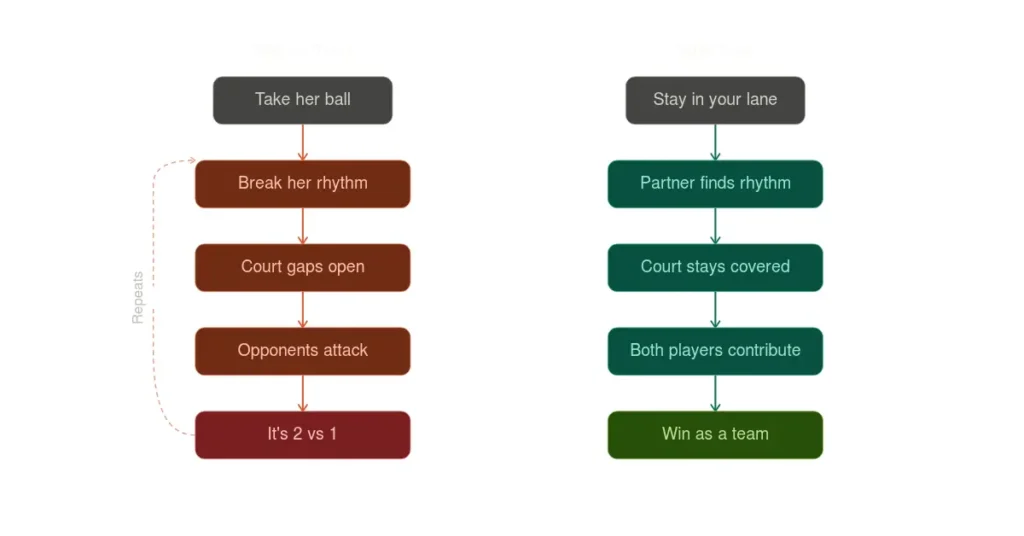
The 2 vs 1 Problem
The moment you step in front of your partner for a routine ball, you change the entire geometry of the point. You are not just hitting one extra shot. You are telling your opponents, go ahead, hit everything to me. And smart opponents will happily accept that invitation.
You might be the better player. You might have a stronger drive and a nastier reset. But pickleball is a game of angles and court positioning. When you overplay, you give up both.
I saw this play out perfectly at a Beer City tournament years ago. I was playing with Jen Roach against John Cincola and his partner. John was individually better than both of us. He could out-dink me, out-drive me, and out-reset me. But John tried to take too much court. He kept stepping in front of his partner to handle balls that she could have handled just fine.
And in doing so, he turned the match into himself versus Jen and me. We won. Not because we were better players, but because John made the court smaller for himself and bigger for us. Every time he moved over, we had a wide-open down-the-line gap. Every time he scrambled back, we had the middle exposed.
The lesson is simple. When you play too big, you do not become a superhero. You become a target. And your partner becomes a spectator.
Destroying Partner Rhythm
There is another cost to pickleball mixed doubles male overplaying, and it is one that rarely shows up on a stat sheet. When you step in front of your partner for a routine dink, you break her rhythm. Not just for that shot. But for the next few shots as well.
Think about how you play when you are in rhythm. Everything feels automatic. You know where the ball is coming. You know your job. You just react. Now imagine that rhythm being interrupted. You are ready to hit a ball. Then suddenly your partner appears and takes it. You step back. You wait. Now the next ball comes, and you are not sure if it is yours or his.
That uncertainty is poison for a pickleball player.
I saw this play out in the PPA Virginia Beach Cup quarterfinals. Noe Khlif and Rachel Rohrabacher were in a tight game. Rachel was in a cross-court dink battle with Paris Todd. She had hit four dinks in a row with no problem. She was locked in. On the fifth dink, Noe stepped in front of her. He hit the same basic ball she had been handling easily. Paris returned it. But now Rachel was out of sync. She missed the next dink.
That miss goes on Rachel’s stat sheet. But it should not. The mistake belonged to Noe. When your partner never knows if the next shot is hers, she cannot find her flow. And a partner without rhythm is a liability, not an asset.
Exposed Court Gaps
You are playing your position. You are in balance. Your partner is covering her side. Then you see a ball drifting toward the middle. It is not attackable. It is just a routine dink. But you step in front of her anyway. You hit the dink back. Now you are out of position. And the court is wide open.
This is the third downside of playing too big, and it is a nasty one. When you step in front of your partner on a non-attackable ball, you create a massive gap. The middle becomes exposed. The down-the-line alley on your partner’s side becomes exposed. Your opponents see this instantly. They will attack that space.
Most of the time this scramble ends with a stressful backhand reset. You are reaching. You are off balance. You are praying the ball lands softly. That is not a winning formula.
Even worse, this imbalance puts your partner in a terrible spot. She was in position. She was ready. Then you moved her out of her spot. Now she has to cover for you. She has to defend a shot that should never have been created. Players who understand court positioning fundamentals know that structure wins more points than athleticism.
The fix is straightforward. If the ball is not attackable, stay in your zone. Let your partner handle her side. Protect the court. Do not expose it.
When To Play Big
So when does it actually make sense to play big? There are two specific scenarios.
The first is obvious. You see a clear attack opportunity. A floating ball in the middle, a high bounce you can drive, a sitter you can put away. Step in, take the shot, and stay aggressive as long as you keep the advantage. That is not overplaying. That is doing your job.
The second scenario is more nuanced. Your partner is being overmatched. She is getting targeted relentlessly and struggling to stay in the rally. In that case, you may need to expand your coverage to keep the team alive.
But here is the critical distinction. This is not an excuse to take over when your partner is holding her own. If she is handling her cross-court dinks and keeping points alive, let her play. A top pro like Rachel Rohrabacher can more than hold her own. When a male partner steps in front of her for routine balls, he is not helping. He is reducing the team’s chances.
The same applies at your level. If your partner is steady, trust her.
The Balanced Approach
You have probably seen the Johnson siblings play. JW and Jorja are one of the best mixed doubles teams in the world. Watch them closely. You will notice something important.
JW reaches in for attackable balls. He poaches when he senses a floater. But most of the time, he stays in his lane. He lets Jorja play her role.
This is the balanced approach that wins matches. It is the default strategy you should adopt. When you are in position, your team plays in rhythm. Your partner knows where you will be. She knows which balls are hers. That certainty lets her relax and play her best.
The ideal male player in mixed doubles reaches in for clear attacks. He steps up when a ball is floating in the middle. But he does not step in front of his partner for routine dinks. He does not try to take over the point just because he can. He trusts his partner. He trusts the system. And that trust translates into wins.
Here is the core takeaway. Play big when you have a clear attack. Play small when your partner is in rhythm. The best teams win because both players are playing well. Not because one player is trying to do everything. Find that balance. Your partner will thank you. And your doubles win rate will go up.
FAQs
Why does overplaying hurt you in mixed doubles pickleball?
When the male player takes too much court, it turns the match into a 2 vs 1 situation. Your opponents can target you knowing you are covering everything. It also breaks your partner’s rhythm and creates gaps in court coverage that lead to easy points for the other team.
When should the male player take his partner’s ball in mixed doubles?
Only on clear attack opportunities like floating balls, high bounces you can drive, or sitters you can put away. The other scenario is when your partner is being overmatched and struggling to stay in rallies. If she is holding her own, trust her and stay in your lane.
How do you know if you are overplaying in mixed doubles?
Watch for these signs: your partner hesitates on balls that should be hers, you find yourself scrambling back to your side after taking a middle ball, and your opponents keep finding open court behind you. If any of these are happening consistently, you are taking too much court.
What is the ideal male role in pickleball mixed doubles?
The ideal male player poaches on attackable balls, covers the middle when a floater appears, and stays in position for everything else. He trusts his partner to handle her cross-court dinks and routine balls. The goal is two players working together, not one player doing everything.