

Every rally has a fork in the road: attack or reset. Get it right and you control the point. Get it wrong and you hand your opponent a free winner. This three-question checklist makes the decision automatic.
The Split-Second Fork
Every pickleball rally contains a moment of truth. The ball comes over the net, and you have to decide in a split second whether to attack or reset. This is the fork in the road that separates good players from great ones.
An attack when you are not ready leads to pop ups and easy counters. A reset when you should attack lets your opponent off the hook. Either mistake costs you the point more often than not.
The pros make this look effortless because they have trained their brains to process three specific factors: ball height, body position, and shot quality. Each one tells you something about whether you should step forward with authority or pull back with patience.
The pickleball attack or reset checklist decision is not about being aggressive or passive. It is about being smart. The best players in the world attack when the situation calls for it and reset when the situation demands it. They do not force anything.
Height and Pace
Two things tell you if a ball is attackable: height and pace.
Height is the easier one to judge. If the ball is above net height when you make contact, you can hit it downward with control. That is your green light. Keep your paddle tip up and ready before the ball crosses the net. If you let the ball drop low or reach for it with a low paddle, your attack will pop up. That pop up becomes an easy counter for your opponent.
Pace is trickier. A fast ball coming at you can be your best opportunity or your worst nightmare. If you are balanced and ready, use the ball’s pace to counterattack. Keep your swing compact and controlled. Do not try to overpower a fast ball. Guide it instead.
If the pace overwhelms you, reset. There is no shame in that. This brings us to the Karma Rule. Hard shots tend to come back hard. Soft dinks slow the game down. Do not attack when you are not ready. Reset to take control.
Check Your Balance
You have evaluated the ball and determined it is attackable. The height is right and the pace is manageable. But are you actually in a position to attack?
Body position is everything. To hit an effective attack, you need forward momentum and a stable stance. Your weight should be moving toward the net, not backward or sideways.
Ask yourself: am I moving forward with my paddle ready and my feet set? If yes, attack. Your forward momentum will generate natural power and control.
But what if you are off balance, outstretched, or scrambling? That is where the Three O’s Reset Rule comes in. If you find yourself in any of these three situations, do not attack. Reset the ball softly into the kitchen instead.
The three O’s are Off Balance, Outstretched, and Off Court. Off balance means you are losing your footing or leaning too far. Outstretched means you are reaching wide for a shot that has pulled you out of position. Off court means you are running or scrambling just to get to the ball.
A reset in these situations is not weakness. It is smart pickleball strategy.
Read the Situation
You have checked height and balance. Now assess your own shot quality and read your opponent at the same time.
Start with your own shot. A good drop shot that lands softly in the kitchen lets you move forward aggressively. Step in and stay aggressive. A mediocre third shot that floats higher than you wanted changes everything. Stay in the transition zone and prepare to reset. A bad drop that sits up high is a red flag. Hold your ground.
Now read your opponent. Their paddle and body language tell you everything. If their grip is loose and their paddle is low, they are likely resetting. That is your signal to step in. If their paddle is up and they are in a ready position, they are looking to counter. Be patient and pick your moment.
This two-part read changes how you play. When you combine your shot quality with your opponent’s readiness, the attack or reset decision becomes much clearer. Players who prepare for pressure situations know that reading the game matters more than raw aggression.
Resetting Like a Pro
Most players treat the reset as a last resort. That is the wrong way to think about it. The reset is a tactical choice that gives you control.
When you reset well, you take the pace off the ball and force your opponent to generate their own power. Most players at the 3.5 level and below cannot generate consistent pace on their own. They need your hard shots to feed off of. Take that away, and they will make mistakes.
How to reset effectively: aim low into the kitchen. Keep your paddle loose to absorb the ball’s pace. Stay compact with no big swings. Use your legs with a wide, balanced stance and bend your knees.
A simple drill: have a partner stand at the kitchen line and fire hard shots at your feet while you stand in the transition zone. Your only job is to soften those shots back into the kitchen. Do this for ten minutes each practice session. The reset becomes a weapon instead of a panic move.
The Checklist
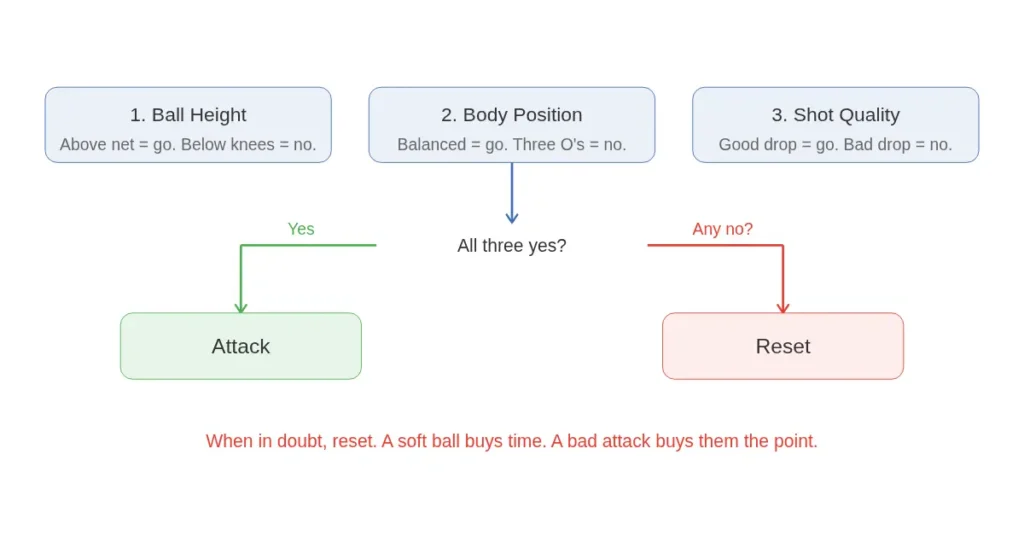
Every decision point in a rally comes down to three questions. Run through them every time the ball comes to you.
Ball height: is it above the net? Attack with control. Is it below your knees? Reset into the kitchen.
Body position: are you balanced and moving forward? Attack. Are you off balance, outstretched, or off court? Reset. This is the Three O’s Rule in action.
Shot quality: did you hit a good shot? Move in and prepare to attack. Did you hit a mediocre or bad shot? Stay back and reset.
Three questions, three answers, one decision. When you practice this checklist in drills and games, it becomes automatic.
Most points are lost because players attack when they should reset, not the other way around. If you are unsure, reset. A soft ball in the kitchen gives you time to recover. A bad attack gives your opponent the point.
Câu hỏi thường gặp
How do you decide whether to attack or reset in pickleball?
Run a three-question checklist. First, is the ball above net height? If yes, you can attack. Second, are you balanced with forward momentum? If not, reset. Third, was your last shot good enough to move forward? These three factors together tell you whether to attack or reset on every ball.
What is the Three O’s Reset Rule in pickleball?
If you are Off Balance, Outstretched, or Off Court, reset the ball softly into the kitchen instead of attacking. These three situations mean you do not have the body position to hit an effective attack. Forcing it leads to pop ups and easy counters for your opponent.
Why do most players lose points by attacking instead of resetting?
Players attack when they are not in position, when the ball is too low, or when their previous shot was mediocre. Each of these creates a weak attack that pops up or goes into the net. A reset in these situations buys time, takes away your opponent’s pace, and forces them to generate their own power.
How do you practice the reset in pickleball?
Have a partner stand at the kitchen line and fire hard shots at your feet while you stand in the transition zone. Your only job is to soften those shots back into the kitchen with a loose grip, compact motion, and low aim. Ten minutes per practice session builds the muscle memory to reset under pressure.