

You watch the pros rip ATPs and spin dinks on YouTube. Then you try it yourself and hand your opponent free points. The gap between what works for pros and what works for beginners is massive. These five habits are keeping you stuck.
Baseline Power Trips
You step up to the baseline and rip a forehand as hard as you can. It feels great when it works. But it probably will not work often enough to matter. Too many beginners, especially those coming from tennis, try to win points from the back of the court.
The kitchen line is where points are won and lost. From the kitchen, you have the most control over the ball. You can attack low balls or defend against hard shots. If you stay back and keep driving, any opponent who knows how to use angles will pick you apart. They will drop the ball short and watch you scramble forward.
The same logic applies to the transition zone. Blasting the ball from midcourt is usually a bad idea. It gives your opponent plenty of time to react and often leaves you off balance.
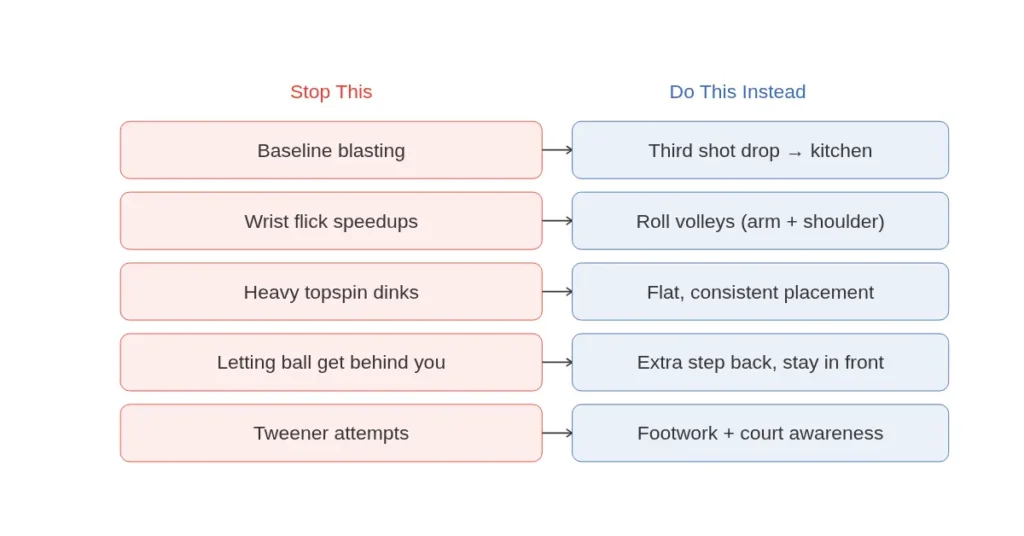
The fix is straightforward. Develop a reliable third shot drop. This shot is your ticket to the kitchen. A soft, looping shot that lands in the kitchen forces your opponent to hit up. That gives you time to move forward and take control of the net. Once you are in position, then you can unleash your offensive game.
Wrist Flick Speedups
You watch the pros hit those quick wrist flicks at the net and the ball rockets down at impossible angles. So you try it yourself. The ball either dives straight into the net or sails three feet long.
That flick shot requires pinpoint control and thousands of reps. Most beginners do not have that kind of muscle memory yet. So your speedups become wildly inconsistent, and you hand over easy points.
Instead, master roll volleys first. Focus on a low-to-high swing path that creates topspin through your shoulder and arm, not just your wrist. This gives you control over the ball’s trajectory. You can keep it low over the net and make it dip down into the court.
Build that consistency before you try adding flair. Your opponents will have a much harder time handling a controlled roll volley than a wild flick that might go anywhere. Players who understand shot selection know that reliability beats flash.
Topspin Dinks Too Early
You have seen the topspin dink that pros use. The ball dips aggressively and lands low in the kitchen. It looks like the ultimate weapon.
Here is the problem. There are only 14 feet between the two kitchen lines. That is very little room for error. When you try heavy topspin without the proper foundation, the ball usually floats too high or hits the net. A high dink is a death sentence in pickleball. Your opponent will smash it at your feet.
Most amateur attempts at topspin dinks fail because the wrist is not stable. You need a locked wrist and a specific brushing motion to generate the right spin.
The smart move is to keep your dinks flat and steady. Focus on consistent placement first. Work on landing your dinks in the same spot over and over. Aim for the middle of the kitchen or the corners. Once you can land 50 straight dinks without missing, then you can start adding finesse.
Solid placement beats flashy mistakes every time.
Ball Getting Behind You
You hustle to the ball, stretch your paddle out, and try to save it. But the ball is already behind you. Your reach is awkward. Your balance is off. You pop the ball up or miss it completely.
It might look like the pros can reach back and save anything, but they are the exception. Most of the time, letting the ball get behind you leads to a weak, floating return or a miss.
The fix is simple but takes effort. Hustle to keep the ball in front of you at all times. If you are even slightly late, take an extra step back. Give yourself more space. It is better to take one more step backward and hit a controlled shot than to let the ball get past you and hit a desperate reach.
This is especially important when you are moving forward from the transition zone. You might be tempted to keep your forward momentum and try to hit the ball early. But if the ball is already past your body, stop. Take that extra step back first.
Good positioning makes every shot easier. Bad positioning makes you scramble. And scrambling leads to common beginner mistakes that hand your opponent free points.
Tweener Heroics
You see a jaw-dropping tweener on a highlight reel and think you could do that. The reality is that tweeners require perfect timing, body control, and a whole lot of luck. Even most pros avoid them unless there is absolutely no other option.
When you try one as a beginner, you are more likely to trip, pull a muscle, or just look silly. The risk of injury alone is not worth the tiny chance of pulling it off.
The better approach is to never need a tweener in the first place. Focus on your footwork. Move your feet to get into position instead of reaching or lunging. Work on your court awareness. If the ball is going past you, you probably took a bad angle or misread the shot.
Skip the highlight-reel heroics. Build a game based on solid fundamentals and smart positioning. You will win more points, avoid injuries, and look like a player who actually knows what they are doing. Players who prepare properly know that consistency beats highlights.
Câu hỏi thường gặp
Tại sao người mới chơi không nên sao chép kỹ thuật pickleball của các vận động viên chuyên nghiệp?
Các vận động viên chuyên nghiệp có hàng nghìn giờ luyện tập ghi nhớ cơ bắp giúp họ phục hồi sau những cú đánh mạo hiểm. Người mới bắt đầu chưa có nền tảng đó. Việc thử các kỹ thuật nâng cao như tăng tốc bằng cổ tay, những cú đánh nhẹ xoáy mạnh và những cú đánh giữa hai chân trước khi nắm vững các kỹ thuật cơ bản sẽ dẫn đến sự thiếu ổn định, dễ mắc lỗi và sự thất vọng.
Thay vì đánh mạnh từ vạch cuối sân, tôi nên làm gì?
Hãy phát triển một cú đánh thứ ba đáng tin cậy, bóng rơi nhẹ nhàng vào khu vực gần vạch ném phạt. Cú đánh này sẽ đưa bạn đến vạch ném phạt, nơi bạn thực sự ghi điểm. Việc đứng lùi lại và tung ra những cú đánh mạnh sẽ tạo cơ hội cho đối thủ có khả năng phán đoán góc đánh tốt khai thác điểm yếu của bạn.
Khi nào thì được phép thêm xoáy lên vào những cú đánh nhẹ?
Khi bạn có thể thực hiện thành công 50 cú đánh thẳng đều mà không trượt, hãy bắt đầu bằng việc chú trọng vào vị trí và sự ổn định trước, sau đó dần dần thêm độ xoáy nhẹ. Đánh xoáy mạnh trên không gian chỉ 4,3 mét đòi hỏi cổ tay phải giữ chắc và động tác đánh bóng cụ thể, điều này cần thời gian để phát triển.
Làm thế nào để ngăn bóng bay ra phía sau lưng tôi?
Hãy nhanh chóng giữ bóng ở phía trước bạn. Nếu bạn chậm trễ dù chỉ một chút, hãy lùi thêm một bước thay vì với tới. Lùi thêm một bước để có cú đánh kiểm soát tốt hơn là với tới bóng một cách tuyệt vọng khiến bóng bay lên cao.